




Unlocking the Power of GIS in Big Data: Challenges and Strategies
In today’s data-driven world, businesses are increasingly turning to Geographic Information Systems (GIS) to make sense of vast volumes of geospatial data. From location and market analysis to consumer behaviour prediction and site selection analysis, GIS enables organizations to visualize, analyze and act on location-based insights. Here at Environics Analytics Ltd. (EA), a leader in data and analytics, we view GIS not merely as a tool, but as a strategic capability that drives decision-making across industries.
This post explores the importance of good GIS practices in big data services, the challenges organizations face, and how we help our clients overcome them through innovative, privacy-conscious solutions.
Why GIS Matters in Big Data Services
GIS transforms raw data into location intelligence that provide customer insights that help businesses to:
- Visualize trends and patterns at scale
- Integrate geospatial data into predictive models
- Understand customer behaviour and market potential
- Optimize site selection and maximize ROI
GIS plays a big role in delivering actionable location-based insights derived from massive datasets for organizations across retail, finance, healthcare, education, non-profit and government sectors.
Key Challenges in GIS for Big Data
1. Scalability and Performance
As the world becomes increasingly data-driven, the volume and complexity of geospatial data, ranging from mobile movement and social media to spatially-linked imagery, continue to grow. Processing and rendering these datasets efficiently are a major challenge. Environics Analytics leverages technologies across storage, computation and visualization, such as Snowflake, Databricks, ArcGIS Enterprise and PowerBI to build an ecosystem that emphasizes cloud-native scalability, real-time analytics and advanced visualization. We do this to unlock the full potential of geospatial data.
Traditionally, to draw location insights from spatial datasets, geospatial analysis is used to find patterns like clusters and nearest points, and then visualize the data using techniques like heatmaps, cluster maps, or proportional symbol maps to highlight density, intensity and distribution. These visualizations make complex geospatial relationships easier to understand and help draw meaningful insights.
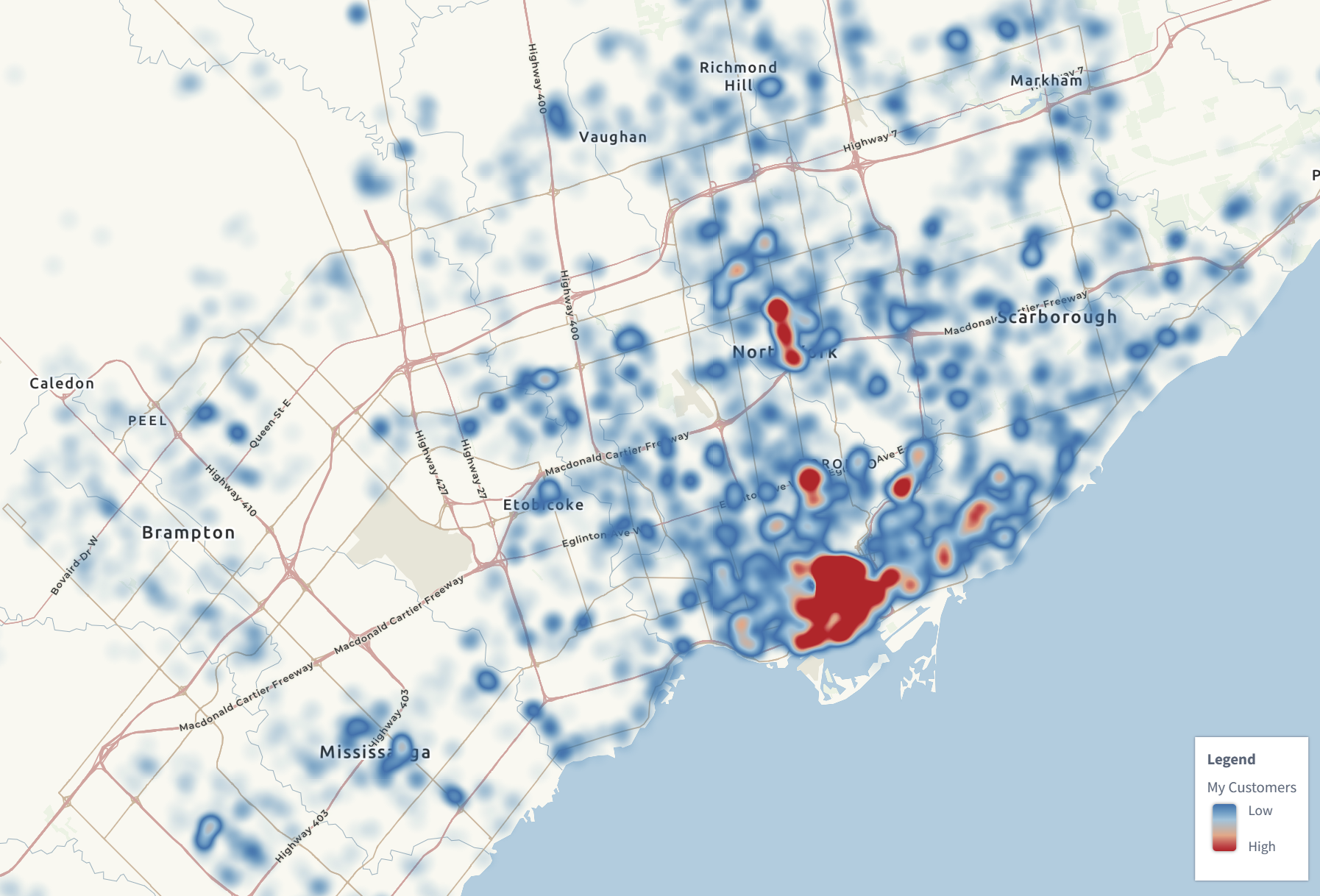
Geospatial Distribution of My Customers in Toronto
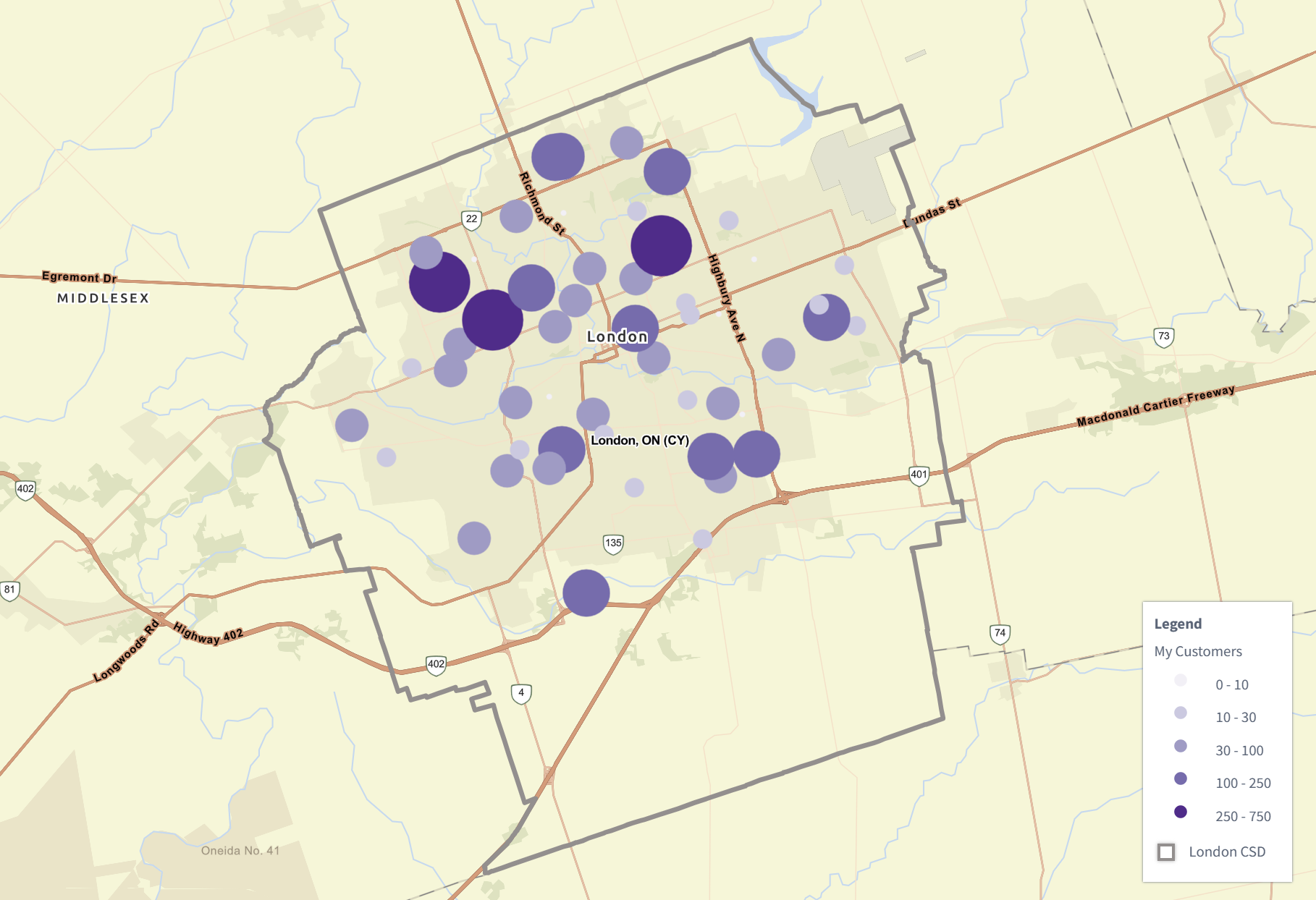
Geospatial Distribution of My Customers in London, Ontario
When the volume of raw data exceeds the browser’s processing and rendering capacity, we, at EA, leverage Snowflake and the Esri technology stack for on-the-fly data aggregation and visualization. In our new version of ENVISION, our next generation SaaS platform, we support multiple ways to summarize geospatial data: from census geographies to H3 hexagons at different resolutions.
Census aggregation uses political or administrative boundaries which allow for analysis within socially meaningful administrative areas.
H3 hexagons are uniform, standardized grids which avoid perceptual bias and prevent the over-emphasis of large, sparse regions.
Data aggregation helps preserve analytical precision while improving performance and readability. It could show meaningful patterns at different resolutions and help visualize the spatial distribution.
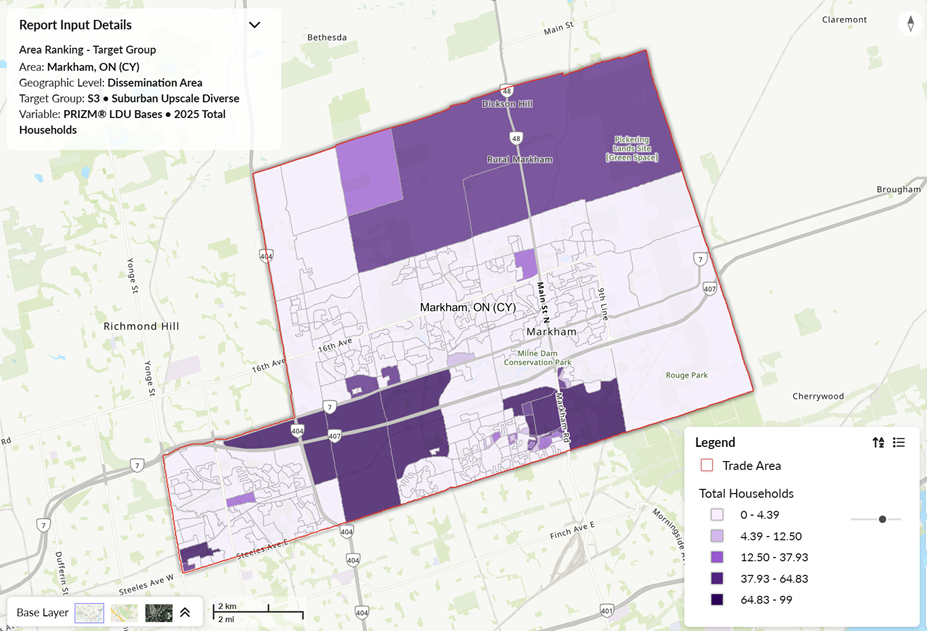
Suburban Upscale Diverse Percent Penetration in Markham (CY)
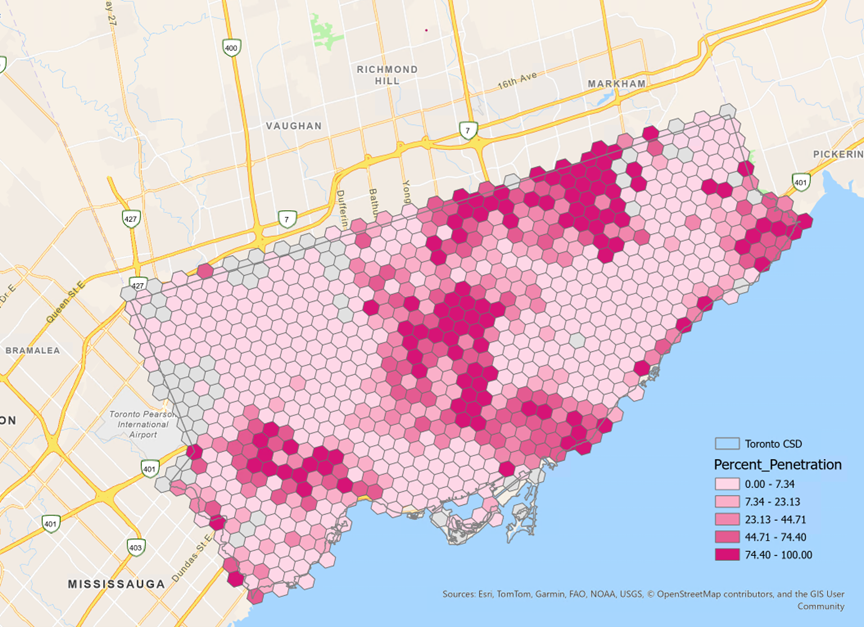
Urban and Suburban Elite Percent Penetration in Toronto (CSD)
2. Data Quality and Integration
Another persistent challenge is integrating data from disparate sources collected at varying geospatial and temporal resolutions. For example, data may be collected at one geographic level, while the analysis requires output at a different geographic level. Without proper modeling and standardization, it could lead to misalignment and inaccurate results.
We use robust methodologies to clean, standardize, and enrich data, ensuring consistency across platforms. Our Data Development and Data Production teams are highly trained in modeling, pre-processing and harmonizing such data. They use proprietary methods along with geospatial apportionment and statistical modeling to standardize and aggregate data accurately, ensuring it aligns with the intended unit of analysis.
3. Observability and Resiliency
Maintaining a robust geospatial infrastructure requires strong observability. If a service goes down, having a process in place to notify, diagnose, and restore functionality quickly is essential. Environics Analytics incorporates observability into its data strategy to ensure minimal disruption and high availability.
Environics Analytics is Esri’s first partner in the world to deploy ArcGIS Enterprise on Kubernetes as a part of a hosted solution. This transforms traditional GIS infrastructure into a self-healing, transparent system, where resiliency ensures 99.9%+ uptime. We also leverage Azure Monitor to monitor system heath and performance while diagnosing issues for backend API services.
4. Rapid Sharing and Feedback Loops
In fast-paced environments, the ability to quickly share analyses and receive feedback is essential. Our ENVISION platform enables seamless collaboration by allowing users to share workspaces, projects and dashboards across teams, improving turnaround times and accelerating positive outcomes.
The Site Modeling offering in ENVISION plays a critical role in helping clients make high-stakes site selection decisions using best-in-class geodemographic and geospatial modeling techniques to accurately predict store performance across multiple candidate sites. The result ensures a site selection strategy that reduces risk, improve ROI and accelerate time-to-market.
5. Data Privacy and Ethics
Geospatial data can reveal sensitive personal information. Even anonymized datasets can be re-identified through location patterns. Environics Analytics is a pioneer in ethical data use and was among one of the first organizations worldwide to receive the ISO 31700-1 Privacy by Design certification.
EA’s privacy-first approach includes:
- Aggregating or de-identifying raw data
- Ensuring units of analysis never reveal individual-level information
- Embedding privacy safeguards into data products from the outset
Conclusion
For a big data service business, GIS is more than a mapping tool. It’s a strategic enabler. Good GIS practices can turn complex geospatial data into clear, actionable insights while maintaining the highest standards of data quality, integrity and privacy.
As geospatial data continues to grow in volume and value, organizations that invest in scalable, intelligent, and privacy compliant GIS solutions like those offered by us in Environics Analytics, will be best positioned to lead in the age of location intelligence.