




PRIZM 2025: Reflecting an Evolving Canada
At Environics Analytics, it’s always an exciting time when we update our PRIZM® segmentation system. PRIZM is updated annually by incorporating newly created postal codes and re-assigning existing ones given that our models of demographics and social values capture change at a postal code level.
But every few years, we do a more comprehensive update: after each Census (taken every five years by Statistics Canada), we determine whether the existing system, overall, still describes the nuances of the Canadian population appropriately. In other words, do the segments or categories themselves need to be redefined? This is important because the utility of segmentation systems is to simplify and organize our understanding of important subsets of the population by getting at the essence of each segment’s distinctiveness from all the others.
Geodemographic systems (PRIZM is one of these) are even more powerful because:
i) they are geographically referenced, which allows segments to be located and;
ii) they easily link to other data (surveys, customer databases and media execution platforms), which allow businesses and organizations to round out knowledge of the segments in a relevant way for their purpose, and to actually reach their desired audience.
Below are several highlights of PRIZM 2025. They describe the changes in the system and point out some patterns we see when we compare how the previous system assigned Canadians to their segment, with the updated version. They show that PRIZM is evolving with the Canadian population, which is a mark of a quality segmentation system.
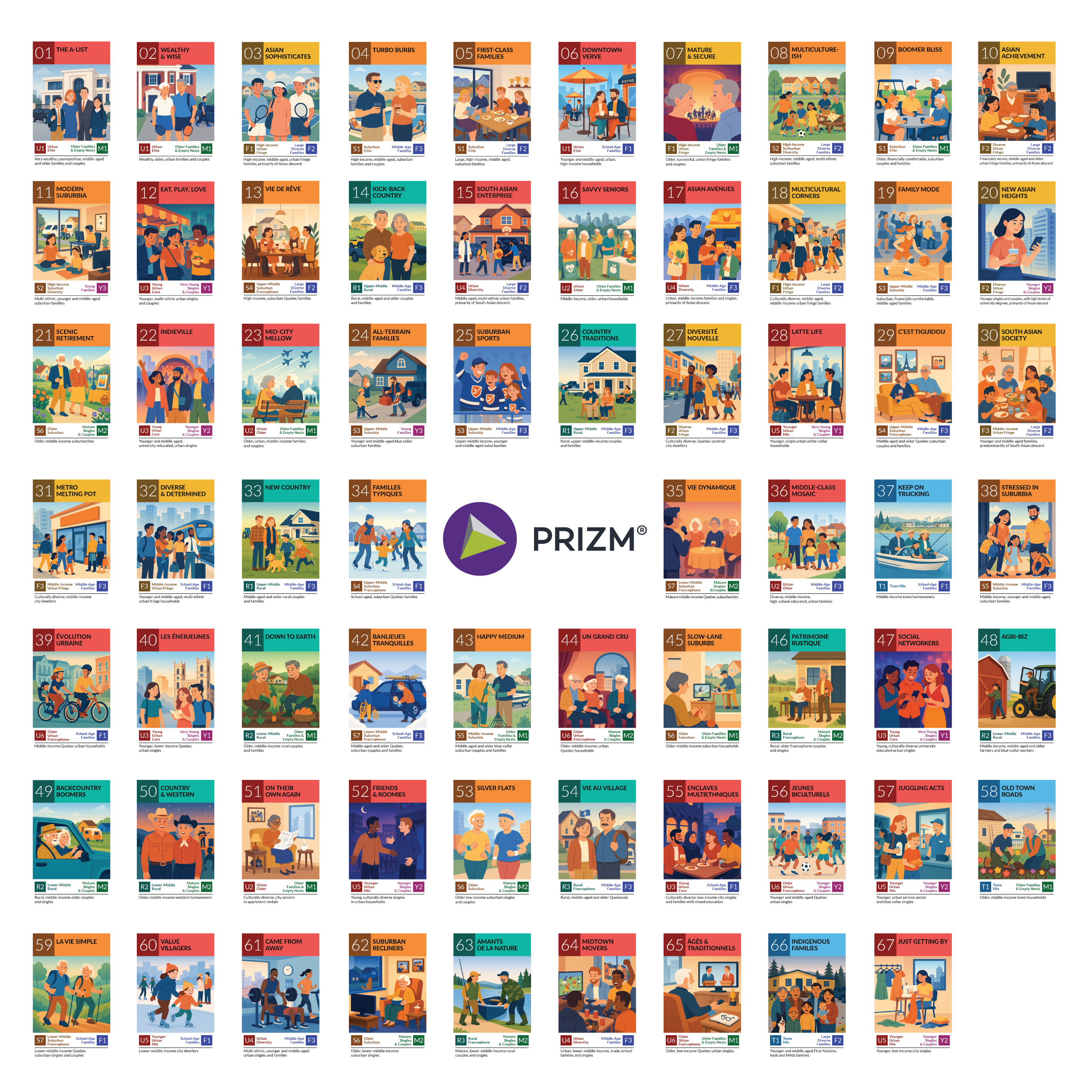
1. No changes to the segment names and socio-economic status indicator (SESI) codes.
We found that the same 67 segments still do an excellent job of describing the nuances of Canadian lifestyles. Some of the segments’ demographics have evolved a bit with an aging population, more immigration and second-generation racialized communities, but there was not enough change needed to retire any segments or create new ones. The descriptions and drawings were updated to reflect these segments’ evolution. The implication for users is that your existing target groups of PRIZMs will likely still be usable, but some changes have likely occurred in their demographics and consumption habits that should be understood.
2. 40% of postal codes changed their PRIZM assignment within the system.
If we compare the assignment of the current universe of postal codes using the 2024 assignment model with the new PRIZM 2025, a substantial 40% changed assignment. Those postal codes represent 33% of Canadian households.
3. The suburbs are where population growth is occurring the most.
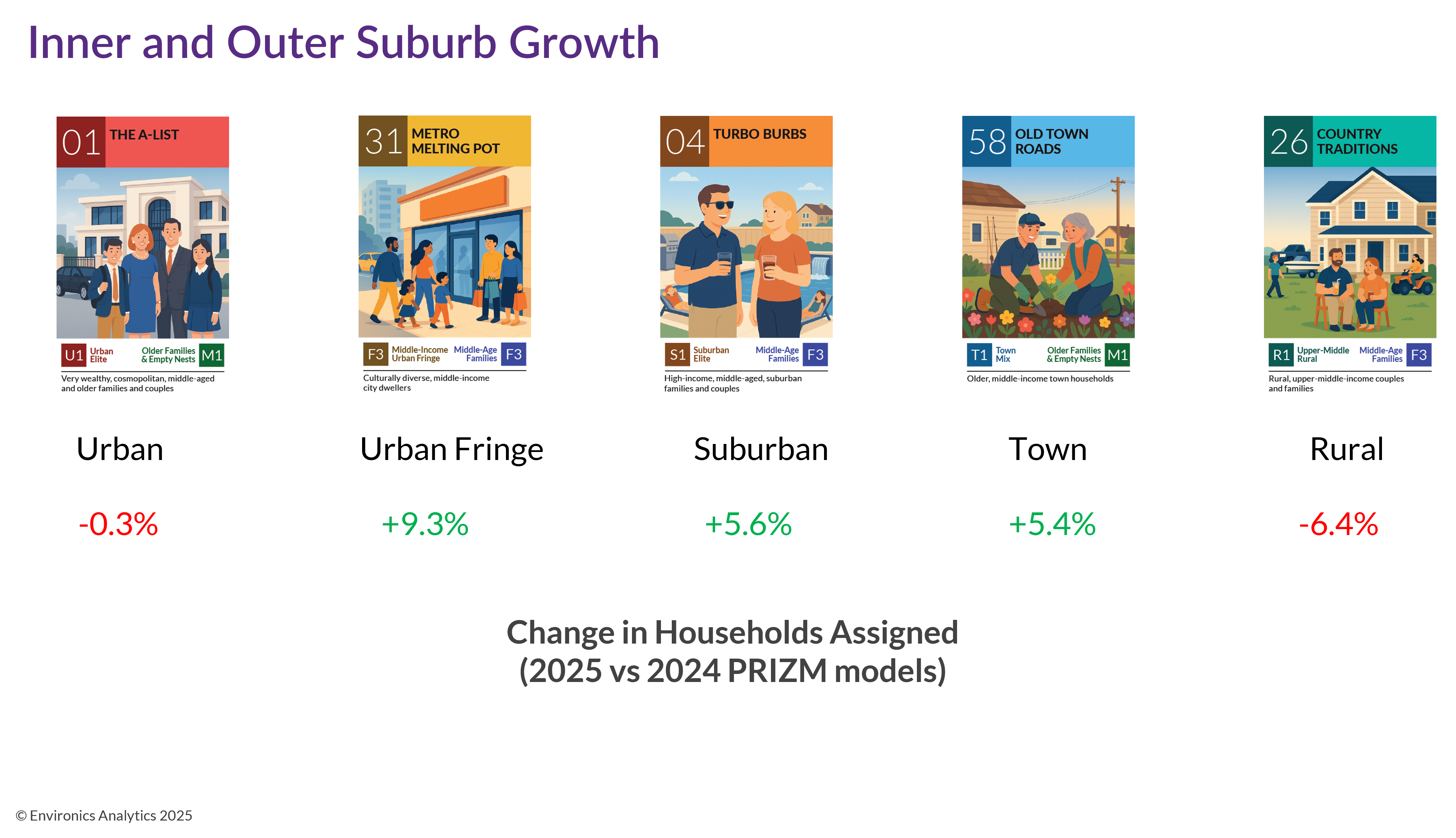
The new PRIZM system assigns 9% more households to the urbanity class “Urban Fringe” (also known as the inner suburbs of cities) and 6% more to “Suburban”. By contrast, “Urban” is flat and “Rural” lost 6% of households.
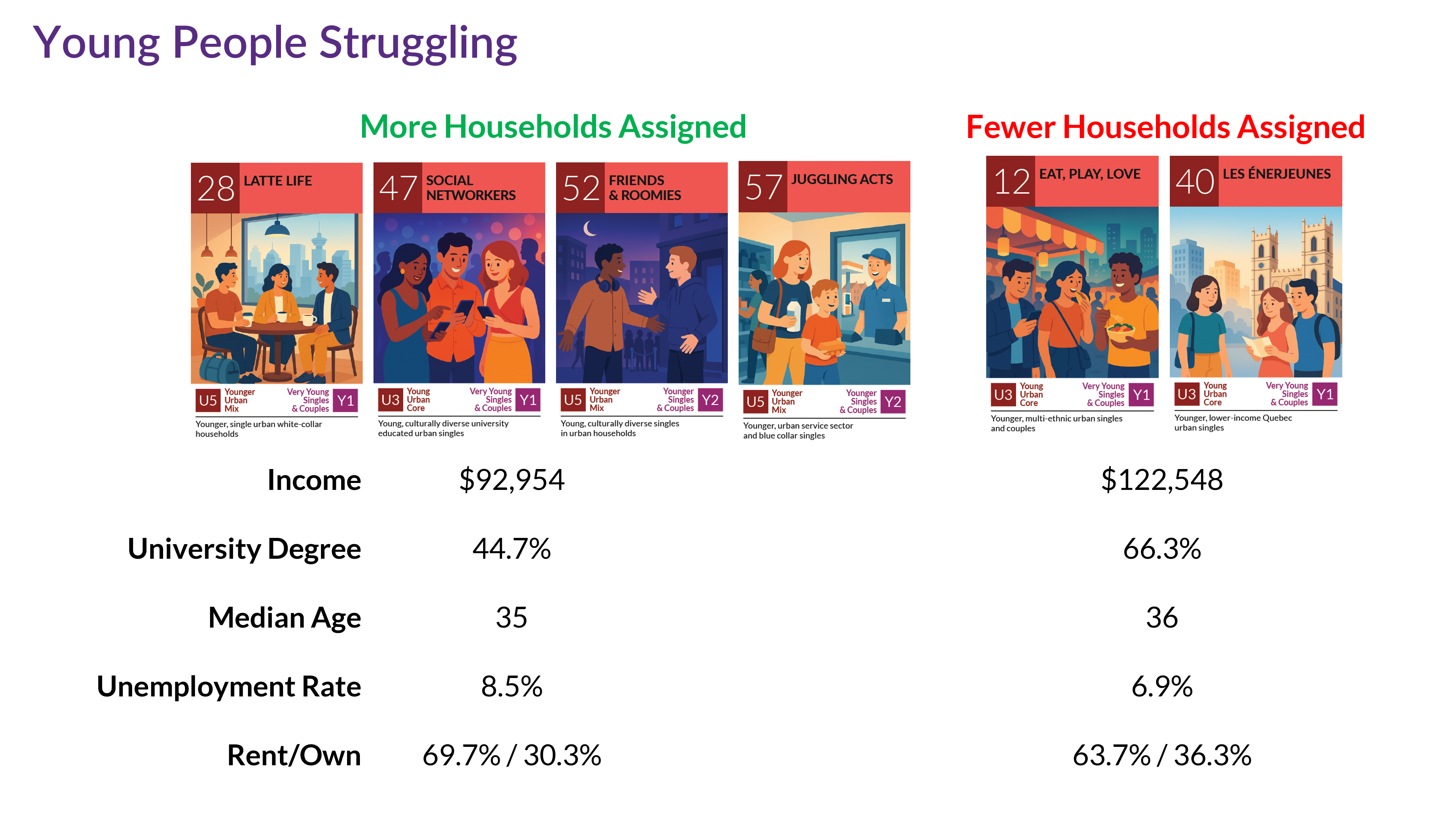
4. Lower SESI young segments grew, while higher SESI ones declined.
It's' been all over the news: young people are struggling with the cost of living, particularly housing, and they are feeling the pressure of these uncertain economic times. We see an increase in households assigned to a group of young segments that have lower incomes, lower educational attainment, higher unemployment and lower homeownership rates. The higher socio-economic status young segments (12 Eat, Play, Love and 40 Les Énerjeunes) in PRIZM saw a decline in households.
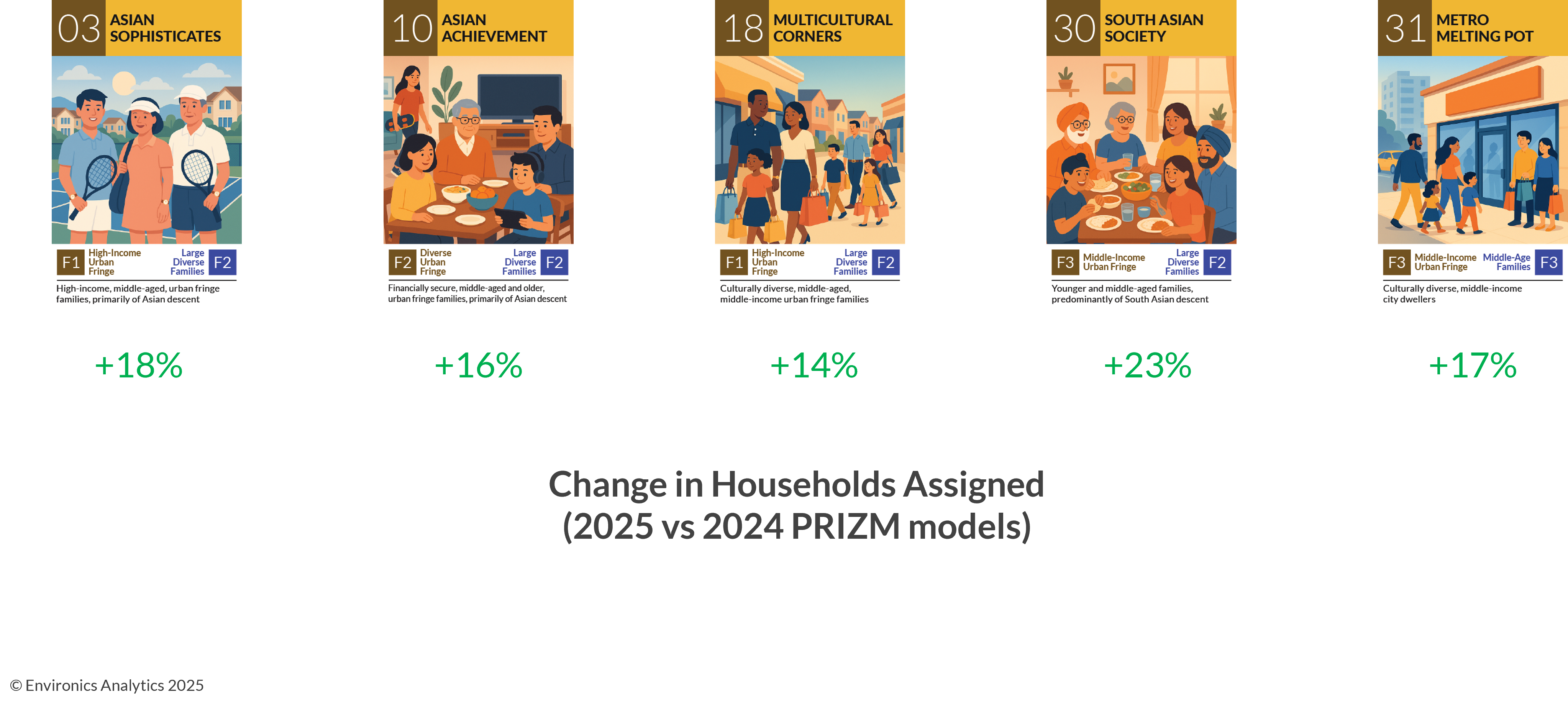
5. More Canadians live in multicultural segments.
Canada's diversifying population is shaping Canadian inner suburbs. Several of our multicultural PRIZMs – both single-ethnicity-dominant segments like 03 Asian Sophisticates or 30 South Asian Society, and more mixed-ethnicity segments like 18 Multicultural Corners are experiencing double-digit percent growth in PRIZM 2025.
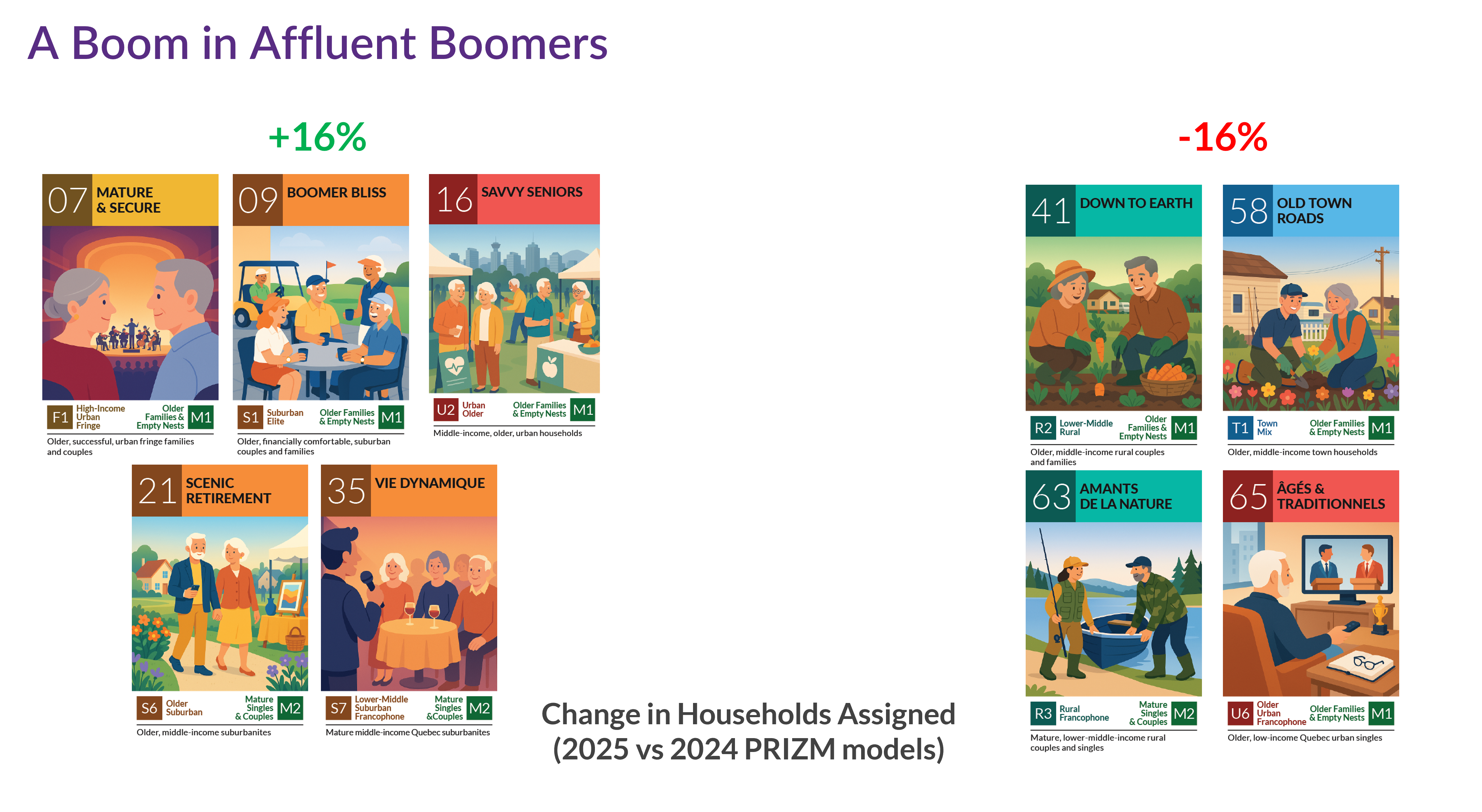
6. There is a boom in affluent Boomers.
Plenty has been written about the Boomers being the most affluent generation in history and how they will shape aging. We are seeing this: a group of more affluent, urban and suburban Boomer-dominant segments have 16% growth in households in PRIZM 2025. More rural, lower-income Boomer segments show a 16% decline.
7. Canadians' social values are shifting.
Canadians have experienced some large shocks with the changing world order and, previously, the COVID-19 pandemic. PRIZM is unique in that powerful SocialValues data help define the segments, ensuring PRIZM teases out Canadians’ hearts and minds, not just demographics. In 2025, we can see shifts in Canadians’ values that reflect the times: increased Civic Engagement, Confidence in Small Business, National Pride and Financial Concern Regarding the Future, and decreased Penchant for Risk, Work Ethic and Culture Sampling.

To learn more about how PRIZM can help you, visit our website or get in touch with us
Explore which PRIZM segments are in your neighbourhood by trying the PRIZM postal code lookup