




If You Could See What Visitors Really Do, What Would You Change?
You’ve felt it.
The pressure is constant. You see the crowds. You know a festival weekend worked. You feel the lift when a major event hits town. But when the conversation turns to why it worked or what to do next, the answers get harder.
Because volume only tells part of the story.
The real questions sit just beneath the surface: Who actually visited? What brought them here in the first place? And once they arrived, what did they do next?
Across Canada, from downtown entertainment districts and cultural attractions to stadiums, waterfronts and outdoor destinations, people are showing up. That’s the good news. The missed opportunity is stopping the conversation there.
When we only talk about “how many,” we leave value on the table.
Why Understanding Visitors and Places Changes the Conversation
What changes the dynamic isn’t more data, it’s better perspective.
Some events bring visitors who travel far, stay briefly and spend intensely. Others draw people from closer to home, who explore more broadly and return. They may be pulling in family groups or singles, people looking for a one-of-a-kind experience or a fun break from the daily grind.
When you understand who is visiting, where they come from, and how they move through a destination, something important happens. Marketing becomes more relevant. Partnerships get smarter. And investment decisions feel more defensible.
At Environics Analytics (EA), we built VisitorView Locations of Interest to answer a very practical question we hear all the time from marketing and insights leaders: What parts of a destination do visitors engage with during their stay?
Not in theory. Not in surveys weeks later. But on the ground. And because our VisitorView data are linked to PRIZM® and demographics, you can build a robust profile of these visitors and then be able to target more of them using refined creative and more efficient media activation.
This kind of understanding helps teams see:
- Which neighbourhoods and attractions truly anchor a visit
- How visitation and visitors shift by season, event or origin market
- Which experiences naturally connect in the minds - and movements- of visitors
- Which moments create first-time visitors—and which ones bring people back?
And answers to these questions fuel the strategy around:
- Where should we invest next year?
- Which partnerships will move the needle?
- Are our campaigns changing behaviour, or just driving awareness?
When marketing leaders can answer these questions with confidence, the ROI conversation shifts.
For Canadian destinations, where geography is spread out and seasonality plays an outsized role, this view matters. It brings clarity to questions that traditional reporting struggles to answer.
Looking Past the Big Moment
Deeper insight comes when you look past the headline, past the event and understand who those moments attract.
A fan who flies in for one night doesn’t experience a city the same way as someone who drives in, kids packed into the minivan, stays longer and wanders beyond the downtown core. When you can see those patterns clearly, you can design experiences and marketing that reflect reality, not assumptions.
Those are very different visitors. And they behave very differently.
Real Examples: Visitors to Montreal and Calgary YTD 2025
Montreal
For YTD 2025, we see that Montreal has experienced almost 7% growth in domestic visitors.
Compared to previous year, the number of visitors who are staying overnight have increased, though they are staying for shorter visits. They could perhaps be coming to Montreal for conferences, as a weekend getaway or midweek break with an average of 2.4 nights per trip versus the previous year. This is a trend we are seeing across the country, where domestic visitors are taking the time to explore more, but perhaps staying fewer nights.

Below, we can see that the top segments going to Montreal in this period are Francophone family segments from suburban and rural areas in the province. These people are most likely looking for easy travel with lots of fun, family-oriented experiences to keep their school-age children entertained.

Old Montreal is a very popular destination for overnight visitors to the city. We also see that convention centres were busy throughout 2025, indicating perhaps a bumper year for conferences and events at these locations.
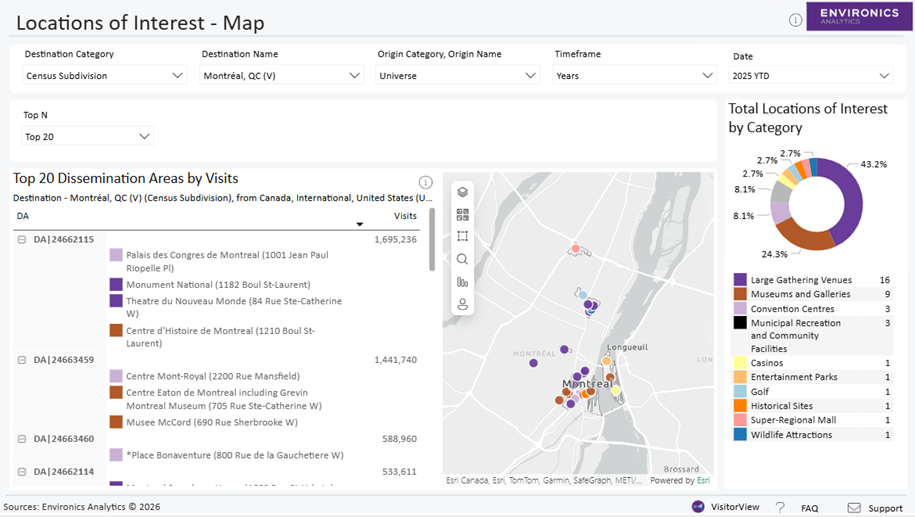
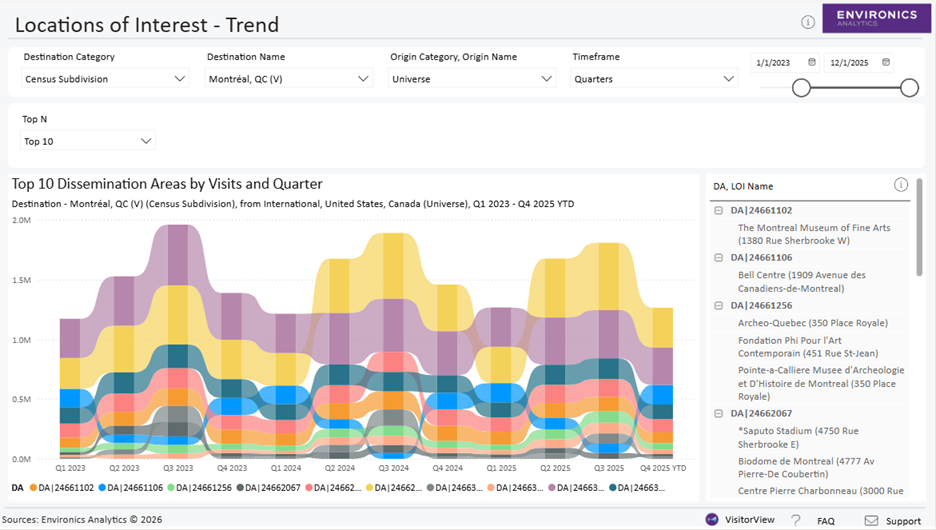
When reviewing quarterly changes, the Montreal Biodome increased their visitation rate exponentially since 2023. It moved into the top 10 neighbourhood rankings for visitors in 2025, displacing the previously top-ranked area of concentrated shopping and shopping malls in the city.
Calgary
Moving across the country, we see that Calgary - and Alberta overall - experienced a stellar year in tourism with double-digit growth across all visitor origins: domestic, U.S. and international. They’ve also seen an increase in the number of nights stayed per trip. This has a positive economic impact as more visitor dollars are spent in the region.

Like Montreal, Calgary sees an influx of visitors from surrounding suburban and rural areas throughout the year. Events like the Calgary Stampede and the Rotary International conference, which Calgary hosted in June 2025, brought folks into the city for extended periods. These two large events attracted unique groups of visitors to the area, a combination of recreational and business travellers.
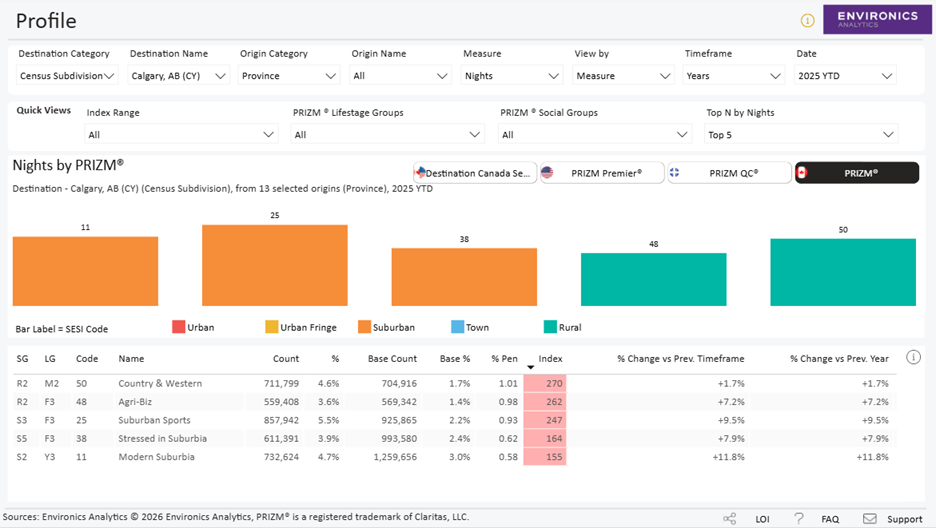
With all the major events that Calgary hosted over the past year, the McEwan Conference Centre is bringing in many visitors from all origins around the city and province.

And with significant investment in the Calgary Arts Common, it is a positive sign that visitation to the neighbourhood increased in 2025 as the area continues to develop and change.

The VisitorView Location of Interest dashboards fill the gaps to questions beyond how many people came to an area, venue or event. They provide insights that empower marketers to be more strategic when building their plans and campaigns, and they help with more efficient media buys. And PRIZM segmentation, a part of the VisitorView Location of Interest dashboards, is available across digital and traditional platforms to target audiences for media activation.
Privacy Isn’t a Footnote. It’s the Foundation.
Of course, none of this matters if trust isn’t built in from the start.
That’s why privacy isn’t an afterthought in how we approach visitor insights. The patterns we look at are aggregated and anonymized. They show behaviour, not people. There is no tracking of individuals and no way to single any one person out.
What this means in practice is simple: marketing and insights teams can ask deeper questions without crossing ethical lines and then bring those insights into the boardroom with confidence.
In a world where consumer trust is fragile, privacy-forward insight isn’t just safer. It’s smarter.
Better Insight Leads to Better Conversations
One of the most overlooked benefits of understanding how visitors move through places is how it changes internal alignment.
It’s when teams can see how visitors disperse across a city or region:
- Marketing, planning and infrastructure start speaking the same language
- Partnerships become grounded in shared opportunity, not assumption
- Investment decisions are based on real behaviours, not anecdotes
It also strengthens collaboration beyond your organization, whether that’s with provincial partners, destination organizations, or national tourism strategies. Evidence creates common ground.
The Real Opportunity
This isn’t about dashboards or data for data’s sake.
It’s about understanding the people who choose Canada’s places: who they are, what draws them in, what delights them and what brings them back.
When marketing and insights leaders have a clearer view of what’s really happening on the ground, they ask better questions. And better questions lead to better decisions, and better outcomes.
If you’re feeling the pressure to prove impact, justify investment or rethink where your next dollar should go, it's time to look beyond the headline numbers.
What would change if you could really see how visitors experience your destination?
If that question resonates, contact us to continue the conversation.
Related Content
Explore the VisitorView Tourism Suite
Download: VisitorView Locations of Interest webinar
Learn how EA helps the travel and tourism sector